Involuntary does not mean harmless
On the BAFTAs, the BBC and what accountability actually requires

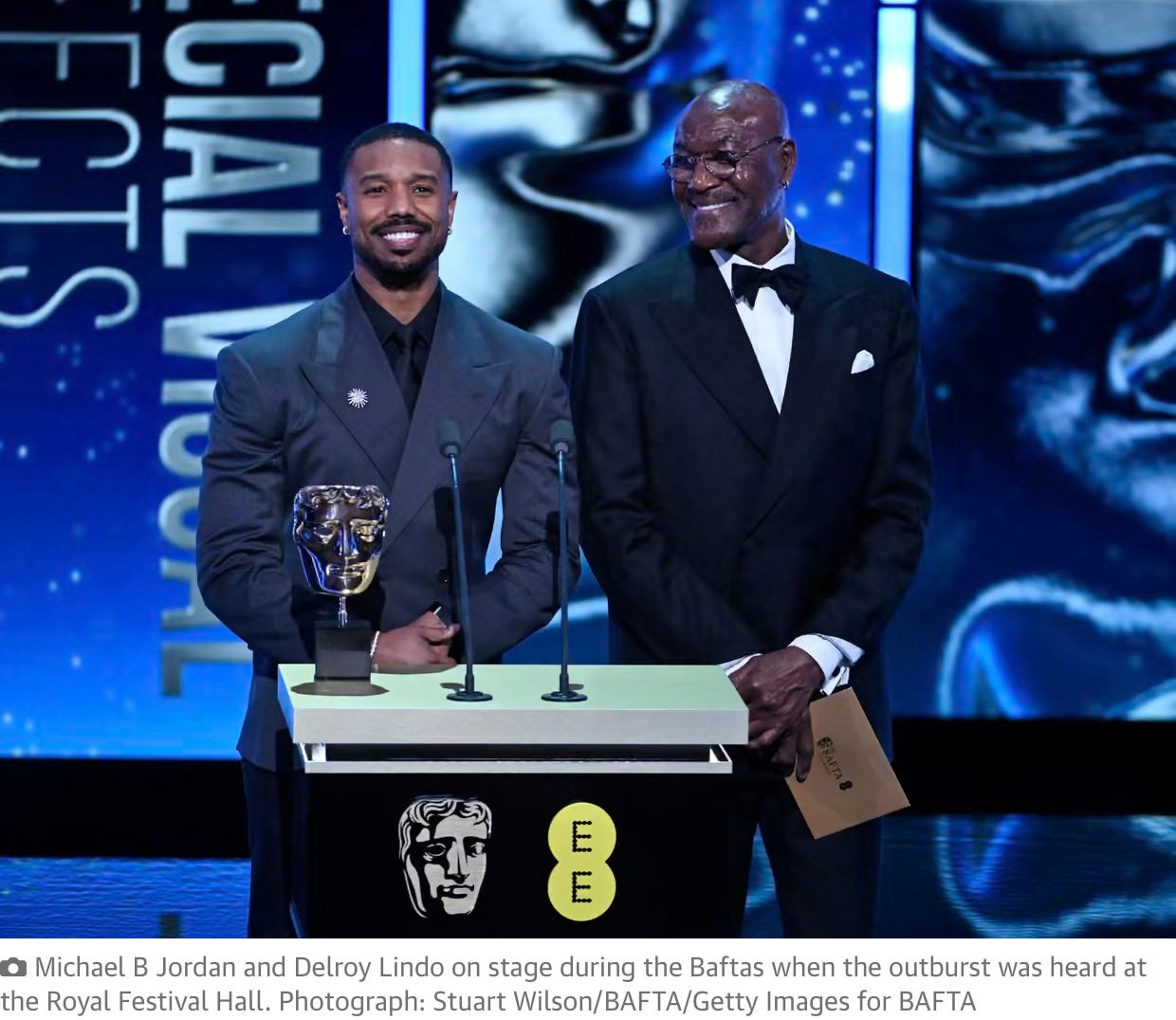
Last night at the BAFTAs, Tourette’s campaigner John Davidson, whose life is the subject of the BAFTA-winning film I Swear, shouted the N-word while Michael B. Jordan and Delroy Lindo stood on stage. The audience had been warned before the show that Davidson has Tourette’s and may make involuntary sounds. The tic was, by every credible account, involuntary.
And none of that changes what needs to happen next.
Involuntary does not mean harmless. If a gun fires without anyone intending to pull the trigger, you do not argue about intent while someone is bleeding. You address the wound. The same logic applies here. The harm to Michael B. Jordan and Delroy Lindo, and to Hannah Beachler, who was also subjected to a slur on the way to dinner, was real and immediate. It does not require intent to be real. It does not require malice to demand a response.
I want to pause on the word being used to describe what happened, because language here is doing quiet, damaging work. Journalists and commentators keep calling it an “outburst.” That word manages to be wrong in two directions at once. It misrepresents the nature of Davidson’s condition, since what occurred was an involuntary tic, not an outburst, which implies a loss of emotional control rather than a neurological one. And it simultaneously softens the impact on the people it struck, in the same way that calling an accidental gunshot “a loud bang” would be technically accurate and morally evasive. The word that was shouted at two Black men on a stage in front of their peers is not an intense noise. Name it or do not name it, but do not reach for a word that obscures what it was and what it did.
That response has two parts. First, a fulsome apology from John Davidson himself, not because he is a bad person or because he chose to cause harm, but because accountability for impact is not contingent on intent. The two men on that stage deserved to hear directly from him that he understood the weight of what occurred, regardless of the mechanism that produced it. Second, an immediate, unambiguous acknowledgement from everyone else involved, not one that led with explanation, not one framed as “if you were offended,” but one that centred the people harmed and named the harm clearly before anything else.
That is not what happened. Alan Cumming’s in-room response prioritised educating the audience about Tourette’s over acknowledging what Jordan, Lindo and Beachler had just experienced. The BBC broadcast the slur on a tape delay, which means there was a window to remove it. They did not use that window. Then they made the full, uncensored version available on iPlayer, compounding the failure, before eventually pulling it hours later. The statement they issued said “we apologise for any offence caused.” Any offence. Caused. As if the harm were hypothetical and the word merely strong.
Wendell Pierce said it plainly: “The insult to them takes priority. It doesn’t matter the reasoning for the racist slur.”
He is right.
Here is what I want to say clearly, because I am already seeing it: making this a debate about disability versus race is a false and damaging choice, and those doing so should stop. Both communities can be failed simultaneously, and in this case, both were, not least because those communities are not mutually exclusive. The question is not whether Tourette’s is a serious and often devastating condition. It is. The question is whether harm to Black people at a public event is addressed with the same seriousness and speed as every other operational consideration. Last night, at the BAFTAs, on the BBC, with (I assume) a tape delay that could have been used and was not, the answer was no.
That is what needs addressing. Everything else is a distraction.
I don’t understand how John Davidson could apologize for anything here. What should he say, exactly? “I’m sorry I have this disability?” “I’m sorry I attended an awards show where a film about me was being honored?” I think the statements could have been better, no question, but talking about “intent versus impact” doesn’t make sense when the act was literally unintentional in the first place; it’s not that he didn’t mean to offend anyone, but that he literally didn’t mean to do anything at all. If someone with a seizure disorder has a fit and ends up slapping me, I’m not going to ask that they apologize for daring to live their lives while epileptic.
It shouldn’t be the case that i only know the nature of the involuntary slur by reading your post. Thanks for enlightening me, and i agree that this has been handled badly.